Making Whole-Person Community Reentry Successful Under CalAIM
Leveraging ECM & Community Supports
California’s CalAIM Justice-Involved Reentry initiative marks a significant shift in how care is delivered to individuals transitioning from incarceration back into the community. When reentry is unsuccessful, the impact extends beyond the individual. It’s affecting families, communities, public systems, and long-term outcomes.
While counties and correctional facilities play important roles, Community-Based Organizations (CBOs) are increasingly central to making reentry work in practice, both before release and well after.
For many CBOs, this moment is both familiar and new. The mission hasn’t changed. What has changed is the scale, structure, and expectations around how reentry work is coordinated, funded, and measured.
What Is the Justice-Involved Reentry Program — and Why It Matters
Under CalAIM, Medi-Cal–funded services can now be delivered to justice-involved individuals up to 90 days prior to release, with an explicit focus on continuity of care after release. These services include Enhanced Care Management (ECM) and Community Supports, designed to address clinical needs alongside housing, recovery, and other social supports.
For CBOs, this matters because:
It formalizes work many organizations have done for years
It introduces sustainable funding through DHCS, counties, and Managed Care Plans (MCPs)
It creates new opportunities, and expectations, for collaboration across systems
In short, CalAIM doesn’t change the mission for CBOs. It raises the operational bar and creates a more sustainable funding model for organizations supporting justice-involved populations.
What It Takes to Deliver Reentry Under CalAIM
Delivering justice-involved reentry under CalAIM requires more than adding a new program. It requires system-level coordination across MCPs, correctional facilities, and wrap-around service providers.
Reentry Is a Continuum, Not an Event.
Care no longer starts at release. It starts before release and continues after into the community. This requires:
Early engagement and intake
Care planning that spans multiple settings
Warm handoffs between correctional partners and community teams
(closed-loop referrals are critical here)
For CBOs, this often means coordinating with partners and systems that operate very differently from traditional community programs.
Data Sharing and Interoperability Are No Longer Optional
CBOs supporting justice-involved populations must increasingly work across:
Managed Care Plans (MCPs) for eligibility, attribution, and ECM enrollment
QHIOs / Health Information Exchanges (HIEs) for clinical data and continuity
County systems and reporting requirements
Common challenges include fragmented data, timing gaps between release and enrollment, and the need to maintain a single, longitudinal view of the member across programs and funding sources.
Spreadsheets and disconnected tools quickly break down in this environment. This increases the concerns for MCPs running risk-based programs and creating friction during one of the most vulnerable transition periods for members.
Multiple Stakeholders, One Member
Justice-involved reentry often involves direct and indirect funding and oversight from MCPs, counties, and DHCS, sometimes simultaneously. CBOs are expected to stand up data solutions that can consistently track and report on:
Eligibility and enrollment
Services delivered
Care coordination activities
Outcomes over time
Data sharing with Managed Care Plans (MCPs)
This isn’t just service delivery. It’s coordinated accountability.
Billing and Financial Complexity
ECM and Community Supports introduce new billing and claims requirements. CBOs must ensure:
Services align with CalAIM program definitions
Units, dates, and authorizations are accurately tracked
Claims are reconciled with MCPs in a timely manner
At the same time, many reentry programs continue to blend CalAIM and non-CalAIM funding. Systems must support both, without duplicating effort or data, because billing delays or errors directly impact financial sustainability.
Why Traditional EMRs and EHRs Fall Short
This is where many CBOs, especially new entrants, encounter friction.
Traditional EMR and EHR systems were never designed for multi-dimensional, multi-stakeholder programs like justice-involved reentry or for delivering whole-person care under ECM and Community Supports. They struggle to support:
Pre-release coordination
Cross-agency workflows
MCP integration
Housing, recovery, and workforce services
Multi-program, multi-payer environments
Complex cross-service assessments and integrated care, service, or housing plans
These systems are often rigid, difficult to adapt, and slow to implement, taking months to configure, at a time when many CBOs need to move quickly.
Justice-involved reentry under CalAIM requires flexibility. Legacy systems were never built for this.
What CBOs Actually Need: A One-Stop, Modern Platform
To succeed under CalAIM, CBOs need a different kind of system:
A single platform to manage members, programs, care coordination, ECM, and Community Supports: from jail to successful community integration
Configurable workflows without heavy customization
Support for whole-person care, not just clinical visits
Fast time-to-value, with implementation measured in weeks, not months
This is especially important for organizations entering the space from different backgrounds, like behavioral health, recovery, ABA, housing, or workforce development, that are expanding into justice-involved reentry for the first time.
How Aztute’s Software Supports CBOs
Aztute was purpose-built to support complex, community-based programs, and not a traditional EHR retrofitted into a whole-person care solution.
We support delivery of multiple programs within a single platform, including justice-involved reentry programs across multiple states, spanning clinical care, housing, recovery, and workforce development. That operational experience now extends into California’s CalAIM ECM and Community Supports framework.
For CBOs, Aztute enables:
Pre- and post-release coordination in one system
Longitudinal member records across programs and funding sources
ECM and Community Supports workflows without heavy customization
Faster go-live, with organizations operational in weeks
The focus is on coordination, continuity, and outcomes, not on managing infrastructure.
What This Means for CBOs
Justice-involved reentry under CalAIM is not a temporary initiative. It represents a long-term shift in how care is funded and delivered for one of California’s most vulnerable populations.
Both established CBOs and new entrants are being called on to play a larger role. Those that invest early in scalable systems, coordinated workflows, and operational readiness will be best positioned to work with counties, DHCS, and MCPs… now and as CalAIM continues to evolve.
The organizations that succeed will spend less time stitching systems together, and more time delivering impact where it matters most.
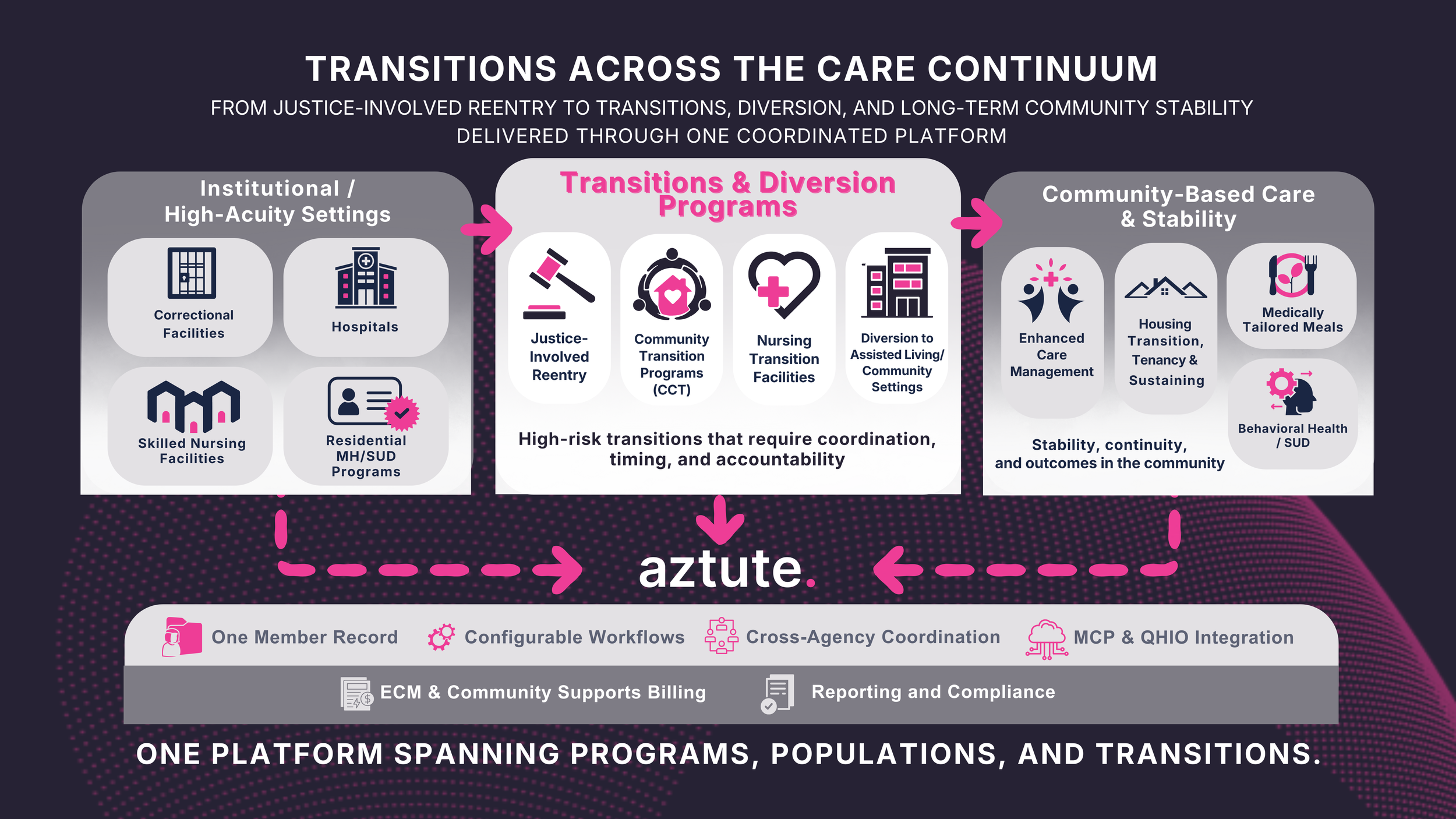
Justice-involved reentry is one of the most complex transitions under CalAIM, but it’s not the only one. Reentry, transitions and diversion programs, and community-based care are all part of a broader continuum that CBOs are being asked to manage simultaneously.
Aztute is a modern, one-stop platform designed to support complex transitions across all CalAIM programs, including ECM, Community Supports, and other community-based programs.